How Is Hispanic Beauty Art Shown in Their Culture
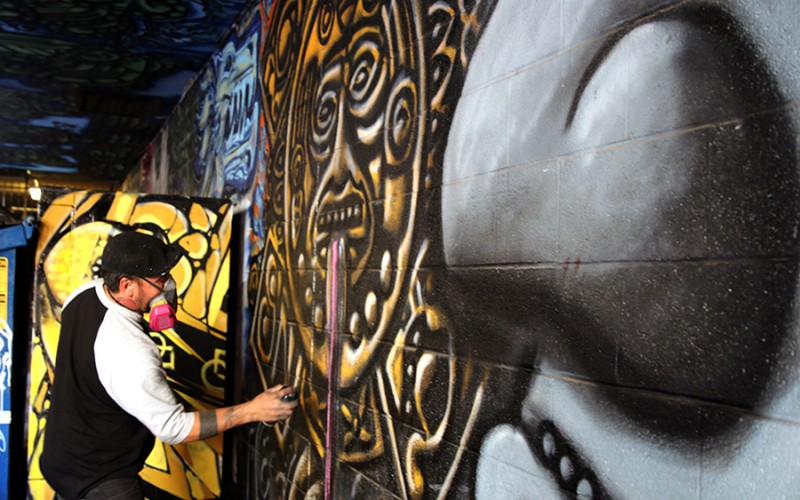
Valley artist Carlos Rivas, 36, works on a portion of a mural in the alley backside the Arizona Latino Arts and Cultural Center in downtown Phoenix. (Photograph by Lindsay Robinson/Cronkite News)
PHOENIX – Scattered across the Valley are vibrant, visual homages to a rich by, present and future. Latino, Hispanic and Chicano art has had an iconic presence in the Southwest for hundreds of years, and nowhere is this presence more striking than in downtown Phoenix. Though Latino artists of all ages in Phoenix share this rich history, their art reflects it in singled-out ways.
While walking the streets in the area, it doesn't take long to notice differences rooted in generation, perspective and identity.
"The art is like classical music," photographer Johnny Lozoya said. "And the street fine art is like punk rock."
The Arizona Latino Arts and Cultural Center's Galeria 147 sits right in the core of downtown Phoenix. Its proximity to the Phoenix Convention Center draws visitors from around the world and gives them a generous taste of southwestern art.
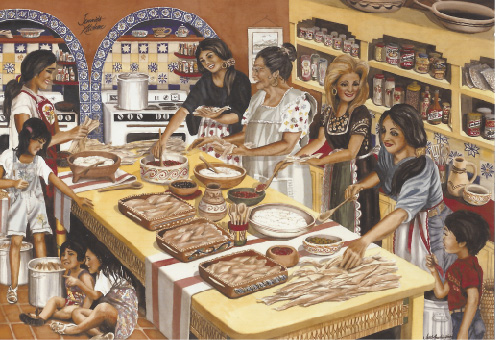
This piece by Girón called "La Tamalada" depicts a kitchen full of mothers, grandmothers, aunts and children making tamales. This piece is on display at the Arizona Latino Arts and Cultural Centre's Galeria 147. (Photo courtesy José Andrés Girón)
The walls at the eye are covered in original paintings past Valley artists, depicting everything from a warm family dinner to iconic Latino figures like Cesar Chavez.
"The Latino art community is very important to the expanse, because we're a good pct of the population," artist and gallery curator José Andrés Girón said. "We want to project the positive view of Hispanics and Latinos. Nosotros want to share our rich culture, because it non simply helps the Latino community, but it besides helps the community at big."
On a slow weekday afternoon at the gallery, lensman and gallery volunteer Johnny Lozoya described the importance of Latino history in Phoenix and fondly reminisced near an event last year where Azteca dancers performed in the streets in front end of the Convention Eye.
"The concluding time that happened on this very spot was thousands of years ago," he said.
Hanging behind Lozoya equally he spoke was a big painting depicting this standoff of cultures, capturing colorful Azteca dancers twirling in front of the downtown Phoenix skyline.
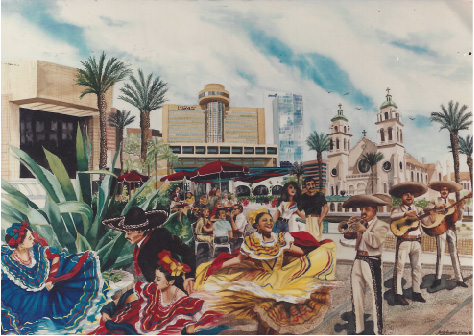
Girón painted this piece to signify cultures and times colliding, all in the core of the city he calls dwelling house. This piece tin be viewed at the Arizona Latino Arts and Cultural Center'south Galeria 147. (Photo courtesy José Andrés Girón)
Artist similar Lozoya and Girón accept pride in their history and culture, and this pride shines through in their art. Many of Girón's paintings apply traditional Latino styles and imagery, from a family making tamales to colorful street fiestas. Girón says this style of art is important to both the region and the world, as it represents immense history, culture and traditions that are unique to this area and valuable to all humans.
A fresh glaze of culture
Just blocks abroad from Galeria 147, many buildings are plastered with some other course of cultural expression. Intricate murals past artists like Thomas "Breeze" Marcus, Lalo Cota and Affections Diaz adorn walls and alleys beyond downtown Phoenix.
Many of these murals embody a fresh take on Latino culture. Vivid colors, funky low riders and edgy Dia de los Muertos skulls run into the eyes of passersby. A new generation of Latino talent has taken to the streets to notice homes for their art.
Carlos Rivas, 36, considers himself outset and foremost a street artist.
"It's my favorite form of art," Rivas said. "I think in some means information technology'south the terminal freedom art has. I'1000 painting buildings, they telephone call it tagging, but really I'm giving y'all this image for gratuitous. You don't have to go to an event or go into a gallery and decide if you lot want the art or not, it's simply at that place, and that'due south powerful."

A portion of the mural in the aisle behind the Arizona Latino Arts and Cultural Center completed by Carlos Rivas. (Photo by Lindsay Robinson/Cronkite News)
While working with the Arizona Latino Arts and Cultural Center, Rivas has learned to better value his art and refined his techniques, but he holds on to his bold style and dearest for street art. He feels a strong connection to his culture and heritage, just he struggles with the idea of art labeled equally "Latino."
"This should be a show almost art, not only Latino art," he said. "Art is art. You shouldn't put labels in front of something and so beautiful."
Rivas and other artists similar him are determined to go out a new marking for their generation.
"Only because you were passed down something, it doesn't hateful information technology's wrong, but it doesn't mean that'south the only manner you tin can exercise something," Rivas said. "What era is this going to be? The era of the repeaters? What exercise yous accept to say? What are yous going to add to this world?"
Rivas said Latino imagery is non his primary focus, but he appreciates these elements in other artists' work. He says that he feels a deep connection to these roots, but he does not let that guide his own art. As he points to a painting in the gallery of ii women smiling and making tortillas, this connection is clear.
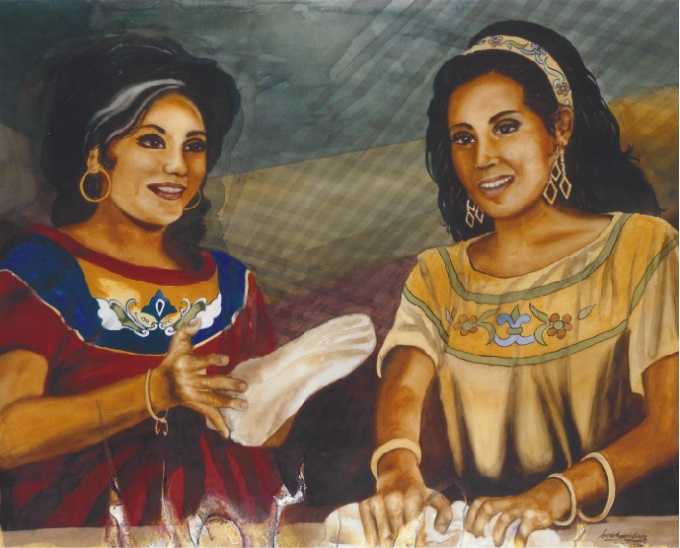
Two women grinning and make tortillas in this warm portrait by Girón. This piece can be viewed at the Arizona Latino Arts and Cultural Heart's Galeria 147. (Photograph courtesy José Andrés Girón)
"That's my mom, that's my aunts. It's beautiful. You're touching the soul with that," he said. "But when the older artists come across our stuff, because it's new, because we're stepping out of the box, sometimes they only don't empathise that. It can be frustrating and discouraging."
Artists like Ivan Garcia, 22, take a similar perspective.
Garcia considers himself a graffiti artist originally. He says that he used to simply paint or tag illegally on the streets, merely he started painting murals and refining his piece of work after becoming involved in an organization called Cyphers a few years agone.
"Murals usually have significant, and a lot of people might not see the meaning on the graffiti attribute of it, but there is really a meaning there," he said. "Information technology'south a totally different earth. People like murals, they don't similar graffiti."

Street artist Ivan Garcia, 22, works on a portion of the landscape backside the Arizona Latino Arts and Cultural Middle. (Photograph by Lindsay Robinson/Cronkite News)
Garcia says that his generation's artists are less influenced by their history and more than interested in creating something new.
"At that place's a lot of meaning in that traditional art, like freedom, and all of those artists have their ain fashion of thinking," Garcia said. "Now the way we think, it's like they already did their part, now let us do our part and create our own way."
Passing down a colorful civilisation
Rivas painted almost exclusively on the streets until he got involved with the Arizona Latino Arts and Cultural Middle. He says that the mentorship, guidance and relationships he has gained in that location take been meliorate for his career than fine art school could accept been.
"By being a curator at ALAC too as an artist here, I become to meet all of these guys, and I mentor some more than others," Girón said. "Those who come up get more inspired, and heck I get inspired past them likewise."
Girón said it is up to the older generations of Latino artists to educate and inspire young creatives.
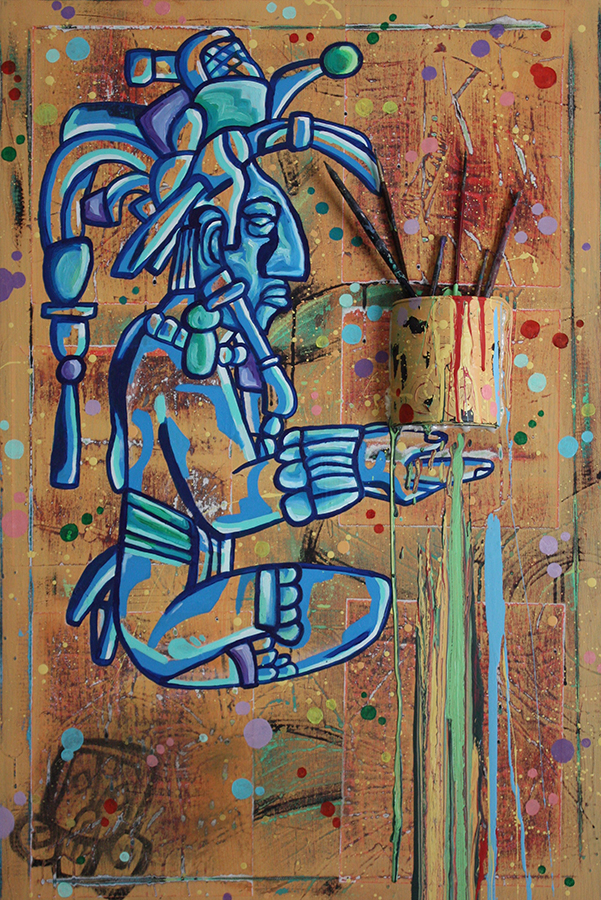
This piece by Edgar Fernandez, titled "This is my Offering," includes features and styles that draw heavily from his Mayan roots. (Photo by Lindsay Robinson/Cronkite News)
"It's up to us to create opportunities for them to learn and connect with their past and their history," he said. "We tin do it through our art and endeavour to influence them to do the aforementioned. But it'due south places like this that give them that opportunity."
While some young artists may not be as influenced by this history, others like Edgar Fernandez, 25, fully embrace it. Fernandez's parents were born in United mexican states, and his Chicano roots are evident in much of his work.
"I bear Mayan descendent roots within me, and I started learning this when I outset started digging into art work," he said. "I had this inner feeling of doing cultural indigenous artwork, and I didn't know why. But I started doing it and finding out little by lilliputian that I had Mayan roots."
Fernandez teaches fine art at a high schoolhouse, and he says his goal is to inspire young artists to embrace and limited their civilization and identity.
"A lot of stuff has been washed downwardly from our culture," he said. "We come from such a rich and cute culture, they had such an avant-garde civilization and their artwork is so beautiful. I recollect that a lot of the youth is not connected to that, so they need older artists and artists like myself to go into the schools and give workshops, mentoring and inspiration."
Generations collaborate, celebrate and create
ALAC has launched a project to revitalize the alley behind Galeria 147. A vibrant mural depicts an array of imagery, symbolism and styles. Artists of all ages — including Rivas, Garcia, Fernandez, Girón and many more — accept collaborated on the mural.
"Once all of these artists put up a beautiful mural with a message of history and a message of the nowadays moment, information technology makes yous go in there and feel comfy," Fernandez said. "I think it'south like a seed, you institute information technology and it's flourishing to create beauty around the downtown area."
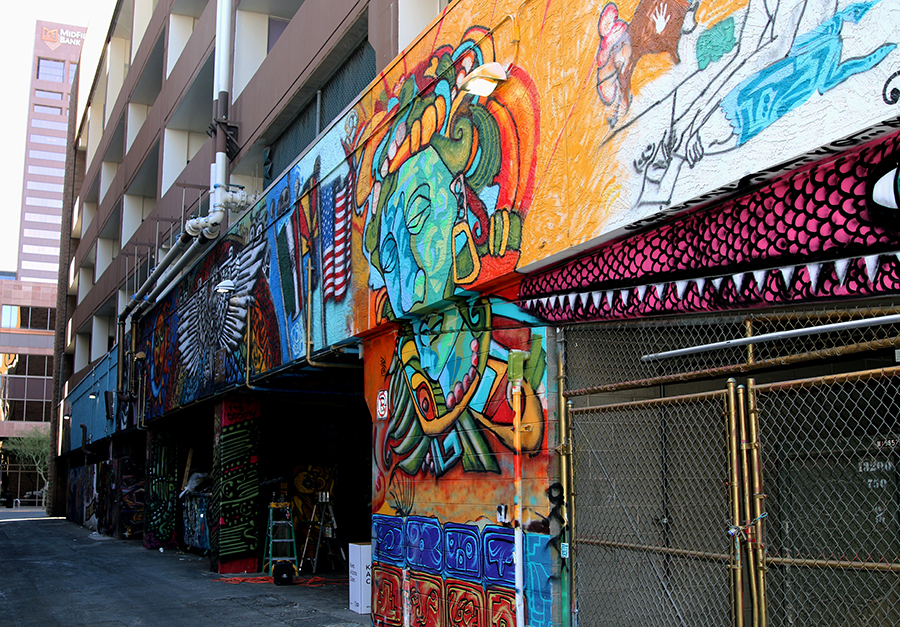
Diverse artists are bringing new life to the alley behind Arizona Latino Arts and Cultural Heart. The mural and alley activation project volition exist completed by the stop of April. (Photo by Lindsay Robinson)
Girón hopes the alley can be an example and inspiration for like projects downtown.
"Latino art in Phoenix is going to grow, it has to grow," Girón said. "Phoenix is getting bigger and bigger, there are more spaces coming upwardly that need decorating, and there's no shortage of upcoming Latino artists, they just demand outlets to display their piece of work."
Valley artists give alley new life
Over the past year, various artists have collaborated to create a landscape and clean up the alley behind the Arizona Latino Arts and Cultural Eye. The photos below highlight their work. (Photos by Lindsay Robinson/Cronkite News)
Arts community comes together to back up landscape projection
People involved in the Phoenix art community gathered on April 3 for a fundraising event to aid support the landscape activation projection. The Cronkite Pivot Bureau asked participants to colour images that represent the Phoenix art customs. Pictured below are participants who shared their drawings. (Photos by Lindsay Robinson/Cronkite News)
EDITOR'S Annotation: Sources in the Public Insight Network informed the reporting in this story through a partnership with the Cronkite PIN Bureau. To send u.s. a story idea or learn more, click here.
Source: https://cronkitenews.azpbs.org/2016/05/21/vibrant-latino-arts-community-reflects-generational-differences/
0 Response to "How Is Hispanic Beauty Art Shown in Their Culture"
Post a Comment